Can a Self-Cleaning Range Hood Really Remove All Cooking Odors? The Science, the Limits, and What to Buy
Lingering kitchen odors are one of the most stubborn problems in any home. After a day of wok stir-frying, slow-roasting, or simmering a spicy stew, that faint, clingy smell can persist for hours-sometimes days-even after you wipe every surface and open every window. For anyone shopping for a range hood, this naturally raises a common question: does a self-cleaning range hood actually eliminate cooking odors completely? As a supplier focused on under-cabinet range hoods, I hear this question constantly. The honest answer is nuanced: it depends on the hood's design, the type of self-cleaning technology it uses, and how effectively it captures and neutralizes the particles that cause smells. This article breaks down the science of cooking odors, explains how self-cleaning hoods operate, and outlines what to look for to get the best odor removal performance.
What Actually Creates Cooking Odors
To understand odor removal, you first need to understand what you are fighting. Cooking generates two main categories of odorous matter: gases and aerosols. Gases are volatile compounds released during high-heat cooking-the sulfur compounds in fried garlic, the aldehydes from overheated oil, and the aromatic molecules produced when roasting meat. Aerosols are microscopic droplets of fat, protein, and spices that become airborne during sautéing, deep-frying, or baking. Most of these particles are smaller than 10 microns-finer than a grain of sand-which is precisely why they float through the kitchen, cling to clothing, upholstery, and walls, and can even seep into adjacent rooms. A standard range hood works by pulling these particles out of the air before they spread, yet many conventional models fail to capture every particle, and grease that accumulates inside the unit can itself become a source of odors over time.
How Self-Cleaning Technology Works
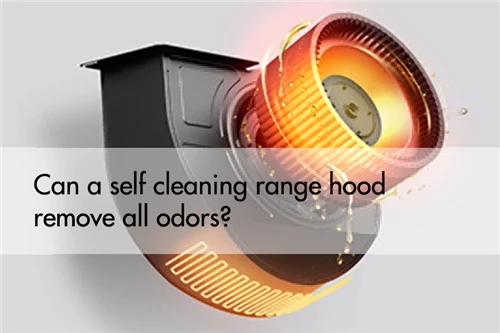
This is where self-cleaning technology enters the picture. Traditional range hoods rely on mesh or baffle filters that catch larger grease particles, but smaller odor-causing aerosols and gases slip through, and built-up grease can turn rancid, adding its own unpleasant smell. Self-cleaning range hoods address this in several ways-though not all use the same method. Some use a hot steam cycle, spraying hot water onto internal surfaces to melt grease, then running the fan to evaporate moisture and flush out residue. Others use catalytic filters coated with a material that breaks grease and odor particles into harmless compounds when exposed to heat. A third approach uses ultrasonic cleaning, which vibrates at high frequencies to dislodge grease without water. All of these methods share one goal: keeping the hood's internal components clean so that odors do not accumulate inside the unit itself.
The Honest Limits: No Hood Removes 100% of Odors
The short answer to the original question is no-no range hood, self-cleaning or otherwise, can remove every cooking odor. There are three reasons. First, no system captures every particle with perfect efficiency. A hood's capture rate depends on its CFM rating (cubic feet per minute, a measure of airflow), its placement relative to the stovetop, and how well it directs airflow. A hood that is undersized or positioned too far from the burners will miss particles before they are pulled in. Second, some odor molecules are exceptionally small and volatile. Catalytic filters break down grease-based odors well but are less effective at very light, fast-moving gases such as the aroma of fresh basil or citrus zest. Steam cleaning can dislodge lighter particles clinging to internal surfaces, but it does not neutralize them as thoroughly as a filter. This is why many modern self-cleaning range hoods combine two or more technologies-for example, a steam cycle for cleaning plus a charcoal or activated carbon filter to trap and neutralize gaseous odors. The charcoal filter is especially important because it adsorbs gas molecules onto its surface, preventing them from re-entering the kitchen. Even charcoal filters have limits, though: they become saturated and should be replaced every six to twelve months depending on cooking frequency.
Debunking the "Zero-Maintenance" Myth
Another common misconception is that self-cleaning hoods can handle heavy odor buildup with no upkeep whatsoever. The self-cleaning function reduces manual scrubbing, but it does not eliminate maintenance entirely. If you neglect the hood's exterior, grease will still accumulate on surrounding cabinets or walls, and those surfaces will release odors long after the hood has done its job. And if you skip replacing a saturated carbon filter, the hood will begin blowing odors back into the kitchen instead of removing them. Choosing the right size for your kitchen and cooking habits matters too. For example, if you regularly cook spicy, greasy meals, a larger model such as a 900mm undermount range hood with a high CFM and a combined steam-and-charcoal system will outperform a smaller, low-CFM unit. A 70cm range hood suits standard kitchens, while an angled range hood may better capture particles from a wider stovetop thanks to its slanted design covering more of the burner area.
Why a Clean Hood Performs Better
There is real science behind why a clean hood is more effective at odor removal. When filters become clogged with grease, airflow is restricted. If the hood cannot pull enough air, odors get trapped inside the unit and recirculate back into the kitchen instead of being vented outside. Self-cleaning systems prevent that grease buildup, so airflow stays strong and the hood pulls in more particles. For ducted hoods-which vent air outdoors and are the most effective type for odor removal-this means more air, and more odors, are expelled. For ductless hoods, which filter and recirculate air, a clean self-cleaning system ensures filters operate at peak capacity before air re-enters the room. This is a major reason frequent cooks prefer self-cleaning range hoods: they avoid spending hours scrubbing filters each month, and the hood maintains consistent odor-removal performance over time.
Managing Expectations with Heavy Cooking
What about intense odors, such as a Thanksgiving turkey roast or a spicy Indian curry? Even a top-tier self-cleaning hood will not eliminate every last trace, but it will reduce smells drastically. The hood captures most large grease particles, and the filter traps most gaseous odors, so instead of smells clinging to your curtains and couch, they linger only near the stovetop. You may still need to open a window or wipe down counters afterward, but the smell will not spread across your home-a clear improvement over traditional hoods that leave grease buildup and odors behind for days.
How to Choose the Right Self-Cleaning Range Hood
If your priority is strong odor removal, focus on four factors. First, check the CFM rating: for most home kitchens, 300–600 CFM is sufficient, but if you have a gas stovetop or cook with a wok regularly, choose 600 CFM or higher. Second, look for a model that combines self-cleaning technology (steam, catalytic, or ultrasonic) with a carbon filter-this dual system handles both grease particles and gaseous odors. Third, match the size to your stovetop: a compact hood suits a single-burner studio setup, while a four-burner range warrants a larger option such as a 900mm undermount range hood or an angled range hood to cover more cooking surface. Finally, prefer ducting where possible: venting outdoors is far more effective at removing odors than ductless models, even with a self-cleaning system.
Sourcing Quality Self-Cleaning Range Hoods for Overseas Buyers: DE&E Appliances
For importers, wholesalers, and kitchen-project contractors, choosing the right self-cleaning range hood is about more than picking a CFM number-it depends on a supplier with proven manufacturing depth, international certifications, and the technical resources to keep odor-removal systems reliable at scale. Hangzhou DE&E Smart Home Co., Ltd., founded in 1992, is a nationally recognized high-tech enterprise specializing in the independent research, development, production, and sales of household kitchen appliances, with a product line spanning eleven categories including range hoods and self-cleaning models. DE&E blends German craftsmanship with Italian design sensibilities and has invested 700 million RMB in the kitchen appliance industry's largest and most advanced Industry 4.0 smart factory-covering 195,000 m² of construction, delivering an annual production capacity of two million units, and maintaining a zero-defect quality-inspection record since launch. Its products are backed by rigorous in-house testing: over 30 specialized laboratories, developed with experts from the China Electric Power Research Institute, conduct safety, durability, airflow, odor-reduction, and grease-separation testing across every product line. DE&E also holds internationally recognized certifications including CCC, CQC, CB, CE, SAA, SASO, SABER, and KC, enabling streamlined market access across Europe, Southeast Asia, the Middle East, and Australia. Backed by an in-house R&D team and a postdoctoral group from Xi'an Jiaotong University, DE&E provides stable production capacity and flexible OEM/ODM customization for regional voltage, plug standards, and appearance requirements-making it a dependable partner for bulk procurement of self-cleaning, under-cabinet, angled, and 900mm undermount range hoods for global markets. To explore the full line and certification resources, visit https://www.deeappliances.com/about-us.
Final Takeaways
A self-cleaning range hood is a powerful tool for keeping kitchens fresh, but it is not a magic solution. It removes nearly all of the odors that would otherwise cling to your home, provided you choose the right size and CFM, combine self-cleaning technology with a carbon filter, and keep up with modest maintenance such as filter replacement. For overseas buyers, pairing professional installation and usage guidance with well-engineered, certified hardware from a capable manufacturer maximizes end-user satisfaction and minimizes after-sales complaints.
References Consumer Reports. (2023). Range Hood Testing: How We Evaluate Performance. consumerreports.org/appliances/range-hoods/how-we-test/ Underwriters Laboratories. (2022). Standard for Range Hood Safety. UL 507. Journal of Food Science. (2021). Cooking Aerosols: Composition, Emission, and Mitigation in Residential Kitchens. Vol. 86, Issue 12, pp. 5217–5231. ASHRAE. (2020). Ventilation for Residential Kitchens. ASHRAE Standard 62.2.
(Word count: approx. 1,450)